
All products
In development Android SMS Gateway

Hiras SMS

Turn your Android phone into a local SMS gateway for developers. Send and receive text messages through your own device and SIM — no third-party SMS provider in the middle.

The problem

Sending a few SMS from your own app shouldn't require a commercial gateway account, per-message billing, and a sign-up flow. For local development, testing, internal tools, and low-volume needs, those services are overkill — and they put a third party between you and your own messages.

Meanwhile, the phone in your pocket already has a SIM, a number, and the ability to send and receive text messages. It's just not something your code can talk to.

The solution

Hiras SMS runs on your Android phone and exposes a small local API. Your backend or scripts make a simple HTTP request; Hiras sends the message through the phone's SIM. Incoming texts are pushed to a webhook you control.

The result: your phone becomes a programmable SMS gateway you fully own — no external SMS provider, no per-message billing for what your own SIM already does.

Features

What it does.

Simple REST API

One POST /api/sms/send with a bearer key — plus health, host info, message history, stats, and diagnostics endpoints.

Local-first & private

The gateway runs on your phone. A local-network guard rejects the public internet; the API key never leaves the device unless you share it.

Multi-SIM support

Pick a default SIM, or target one per request with an optional simSlot. One app, one API, one key.

Two-way over webhooks

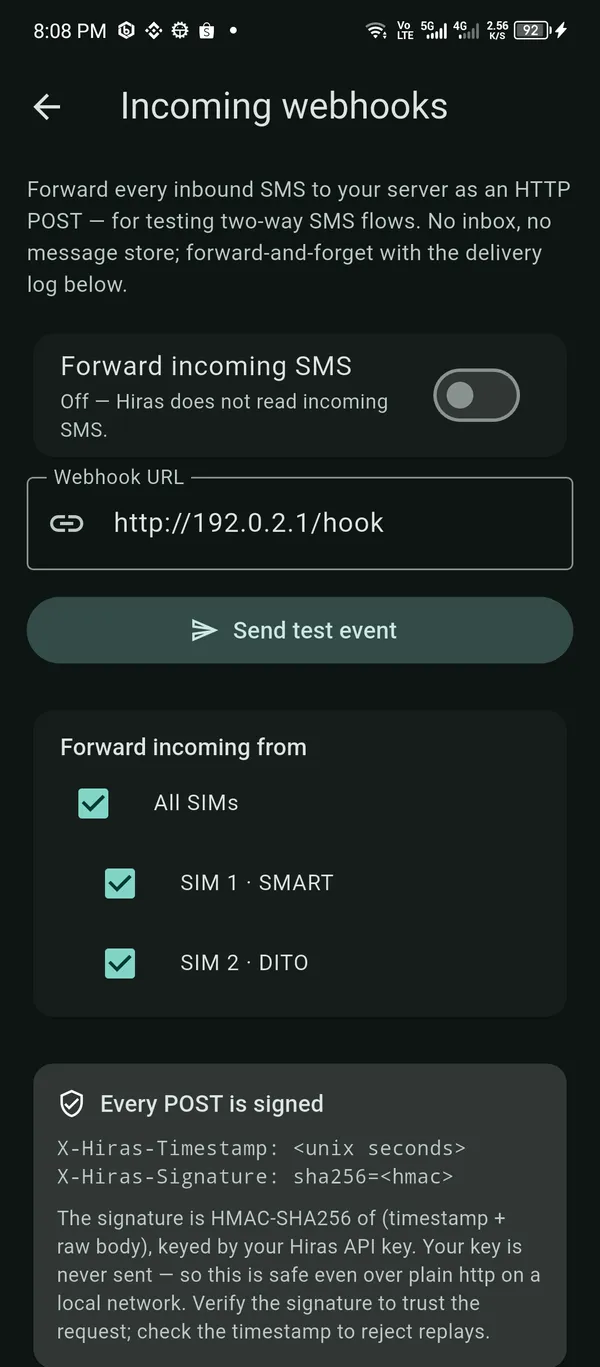
Inbound texts are POSTed to your backend as HMAC-signed webhooks — your API key is never transmitted, and there is no stored inbox.

Zero-cost test modes

Dry Run and Failure Simulation exercise the full API without sending a single real SMS or spending any load.
Truthful history & stats

On-device SQLite records each send as sent or failed, with today/month totals. Stored locally, never uploaded.

Architecture

How it fits together.

Three parts, one direction. Your code talks to the phone; the phone talks to the carrier.

Your backend App, script, or server
Hiras on your phone Local API + gateway
Carrier Delivers the SMS

Inbound messages travel the same path in reverse — the carrier delivers to your SIM, Hiras forwards to your webhook.

Screens

The app.

A local gateway with a real control surface — start it, forward inbound SMS, and check its health at a glance.

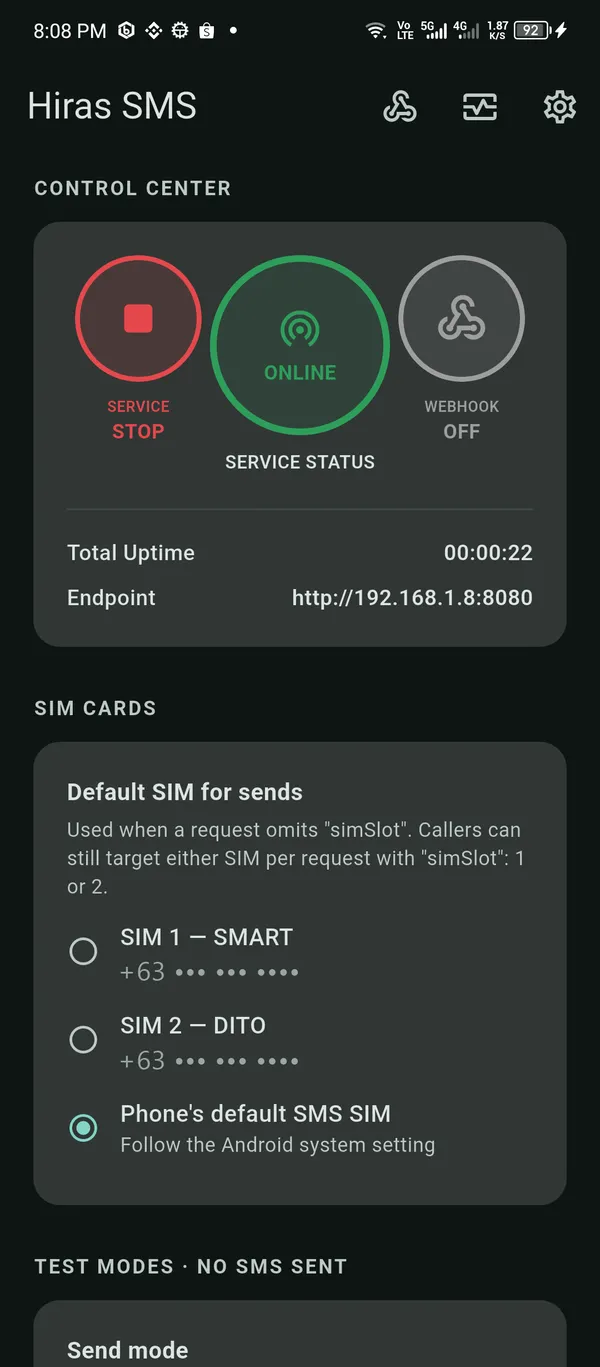
The Hiras SMS control center: the gateway online, with total uptime, the LAN endpoint URL, and SIM selection.
Control Center
The incoming-webhooks screen: forward toggle, webhook URL, per-SIM filter, and the HMAC signature headers.
Incoming webhooks
The diagnostics health check: gateway online, SMS permission granted, Wi-Fi lock held, endpoint, and SIM cards.
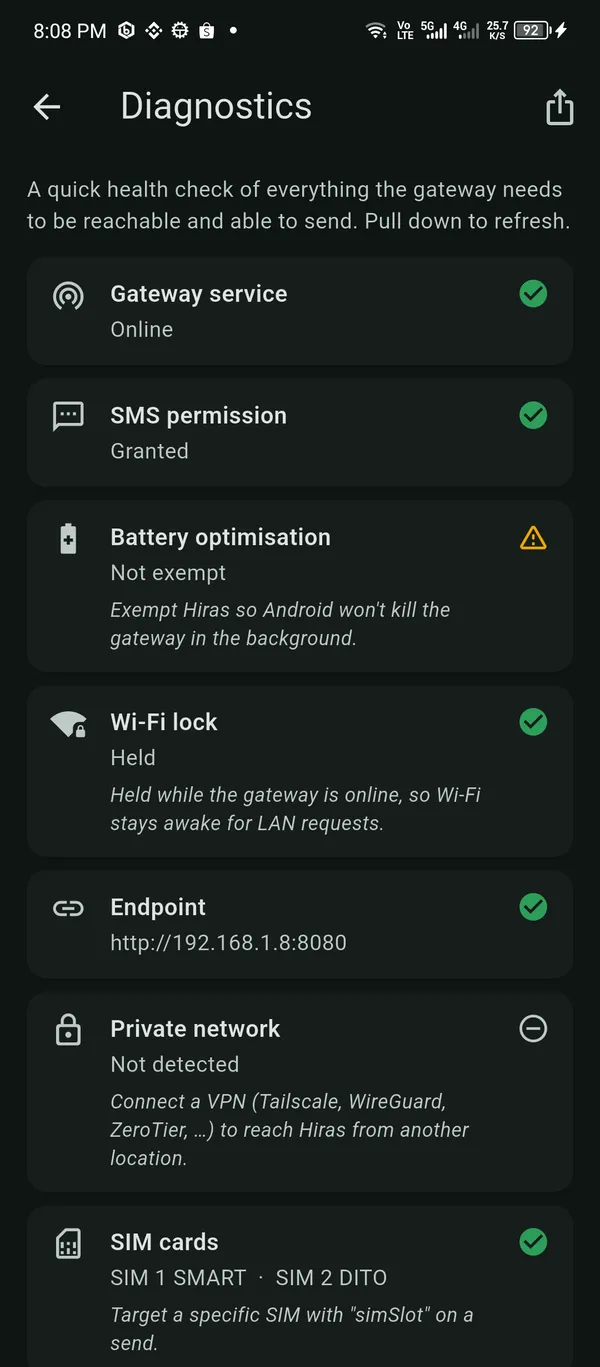
Diagnostics
Documentation

Docs that respect your time.

Good documentation is part of the product, not an afterthought. The full reference is live now — setup and installation, every API endpoint, authentication, webhooks, the built-in test modes, security, and troubleshooting.

FAQ

Questions.

Who is Hiras SMS for?

Solo developers, students, and indie hackers who need to send or receive SMS for local development, testing, or a low-volume integration — using a phone and SIM they already have. It is deliberately not a bulk-messaging or marketing platform.

Does it work without an internet SMS provider?

Yes. Messages go through the phone’s own SIM and carrier. There is no third-party SMS API in the path, and no per-message commission.

Will I know if a message was actually delivered?

Hiras reports queued, then sent or failed, based on what Android tells it. There are no carrier delivery receipts — it can confirm a message was handed off, not that it landed.

Is there an iPhone version?

No. iOS does not let a third-party app send SMS silently, so Hiras is Android-only (8.0 or newer) — a platform limitation, not a roadmap item.

Where does my data live?

On the device. Send history is kept in on-device SQLite (newest 1,000 messages) and is never uploaded. Hiras collects no analytics, telemetry, or crash reports.

More questions in the full FAQ